Blog

By:
Maninder Sidhu
Published

Every staffing firm eventually hits the same wall: payroll runs weekly, but clients pay on net-30, net-45, or net-60 terms, and the gap between those two calendars doesn't close itself. Two tools get pitched as the fix, invoice factoring and AR automation, and they get talked about as if they're interchangeable. They're not. For a firm thinking beyond this quarter's payroll run, AR automation is generally the better long-term strategy, because it closes the timing gap at the source and gets cheaper as the firm scales, while factoring is a cost that recurs on every invoice and tends to grow alongside the business rather than shrinking. Factoring still earns its place as a short-term bridge, particularly for firms too new or too thin on working capital to wait out the switch. But as a permanent operating structure, the two aren't equally durable.
What each one actually does
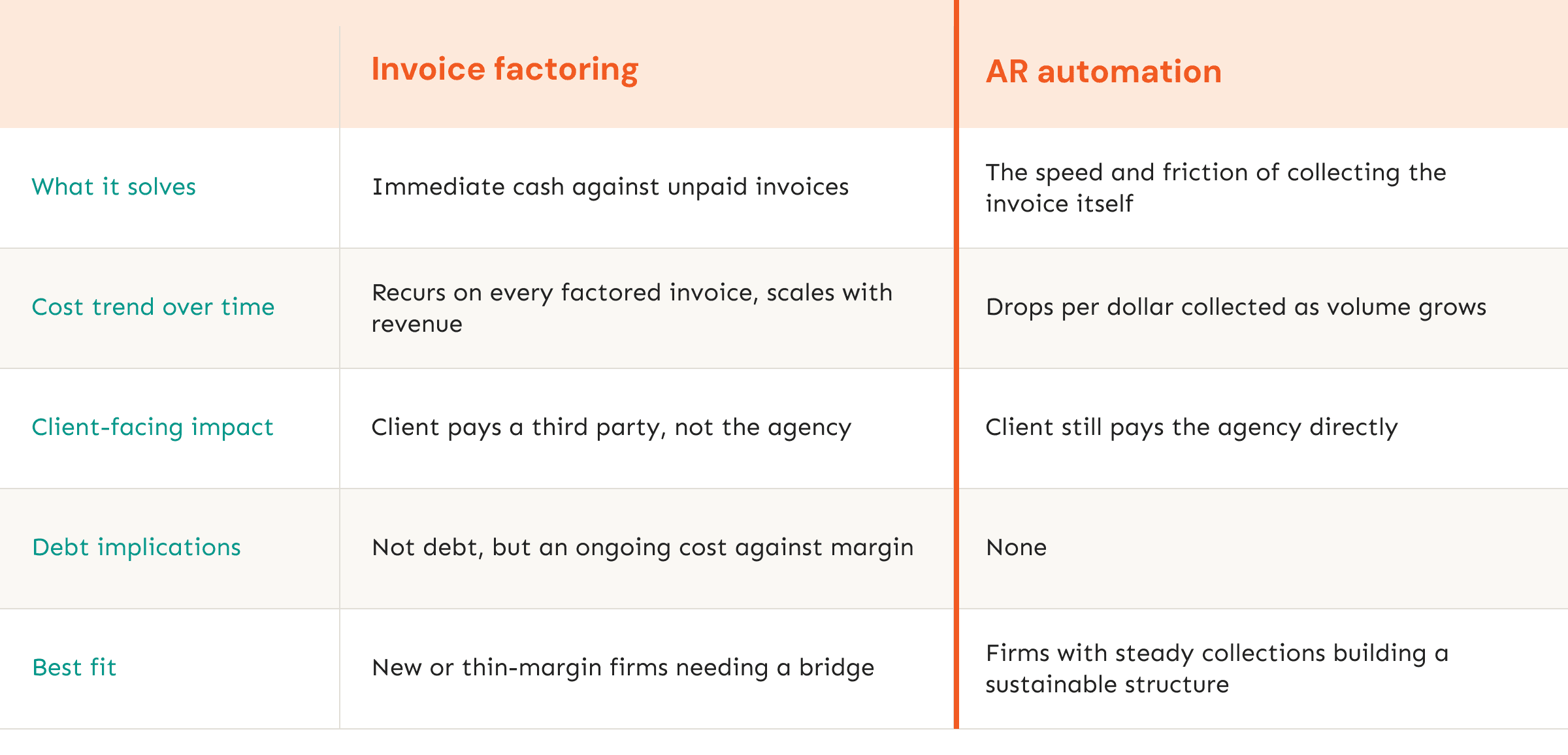
Invoice factoring sells your unpaid invoices to a third party, which advances 80% to 95% of the value upfront and collects from your client directly. AR automation doesn't sell anything. It speeds up how fast you invoice, how easily clients can pay, and how quickly that payment gets reconciled against your books, closing the payroll-to-collection gap by collecting real cash faster instead of borrowing against cash you haven't collected yet.
Why the cost structure matters more than it looks like it does
Factoring fees for staffing firms typically run 1.5% to 3.5% of invoice value per 30-day period, and that fee grows the longer a client takes to pay. A firm factoring $300,000 a month at a 1.8% flat rate, with clients averaging 42 days to pay, runs a monthly factoring cost of roughly $7,600, which is about 2.5% of revenue and can eat close to 17% of gross profit on a typical staffing margin. That's not a one-time setup cost. It's a permanent tax on every dollar the agency bills, for as long as the firm keeps factoring, and it scales up in direct proportion to growth rather than down.
AR automation runs the opposite direction. The fixed cost of building faster invoicing and payment collection doesn't grow with revenue the way a per-invoice factoring fee does, so the more a firm bills, the smaller that cost becomes as a share of the total. A firm that fixes its own collection speed keeps the margin factoring would have taken.
The client relationship difference is easy to underweight
When a firm factors, the client's payment relationship shifts to the factoring company, sometimes formalized through a notice of assignment. Clients notice this, and some corporate AP departments are wary of it. AR automation changes nothing about who the client pays. It just makes paying the agency directly faster and easier, through instant transfer, ACH, or card, with the invoice and payment syncing automatically to the agency's own books. The agency keeps full ownership of the client relationship either way, which matters more the longer that client relationship is expected to last.
Where factoring still makes sense
None of this means factoring is a mistake. A newer agency without the collections history or working capital to survive a slow-paying quarter often needs the bridge factoring provides, and a firm scaling fast, where every $1 million in new revenue can require $80,000 to $120,000 in additional working capital just to cover the payroll-to-collection gap, may not have another option in the short term. The distinction that matters is treating factoring as a bridge to be crossed, not a permanent operating model. The American Staffing Association puts total U.S. staffing industry revenue at roughly $183 billion, and reports that payroll accounts for 75% to 85% of a typical staffing firm's total expenses, which is exactly why the cash flow mechanics here matter at real scale, not just for firms in genuine short-term distress.
Building toward the long-term version
The firms that eventually get off factoring tend to do it by attacking the collection cycle directly rather than just accepting it and financing around it. That means invoicing the moment hours are verified instead of batching at month-end, giving clients frictionless ways to pay, and reconciling payments automatically instead of manually matching bank deposits to open invoices. Forwardly for staffing is built around exactly that shift: recurring invoicing and Auto Payments for predictable clients, instant transfer and ACH options that shrink the time between invoice and payment, and automatic sync to the agency's accounting system so nothing has to be reconciled by hand. We've written previously about how staffing agencies manage payroll before client payments arrive.
The honest version of this decision isn't factoring versus automation as a permanent either-or. It's recognizing that factoring buys time, and automation is what a firm does with that time so it doesn't need to keep buying it indefinitely.
By:
Maninder Sidhu
Published