Blog

By:
Maninder Sidhu
Published

Every product that crosses a border carries a tariff, which is a government tax on imports meant to protect local industries, balance trade, or react to foreign policy moves.
For businesses, tariffs are simple math. They are included in your total landed cost, which shapes the true cost of getting goods to your warehouse or customers.
Take the U.S.-China trade tensions as an example. In 2019, tariffs on some goods jumped from 10% to 25% almost overnight, turning a $100 item into $125 before shipping or storage. And in 2025, evolving tariffs on a wide range of goods continue to impact costs, margins, and supply chain planning for businesses.
For small and medium-sized businesses (SMBs), even a small tariff hike can mess with pricing models and margins. The Bredin survey of 500 SMB leaders found that mid-sized business owners rank rising costs as their top concern after access to capital, a clear sign that tariffs are more than policy; they’re a cash flow problem.
How tariffs impact small and medium-sized businesses?
Tariffs hit SMBs right in their unit economics. Where large corporations can shift suppliers or negotiate large-volume discounts when tariffs rise, SMBs often have fewer options and smaller margins. A small rise in duty can hurt their whole process.
Let’s take a simple example. An SMB imports components at $100 per unit from overseas. Shipping, insurance, and logistics add another $10, bringing the landed cost to $110.
Now, add a 15% tariff on the imported component:
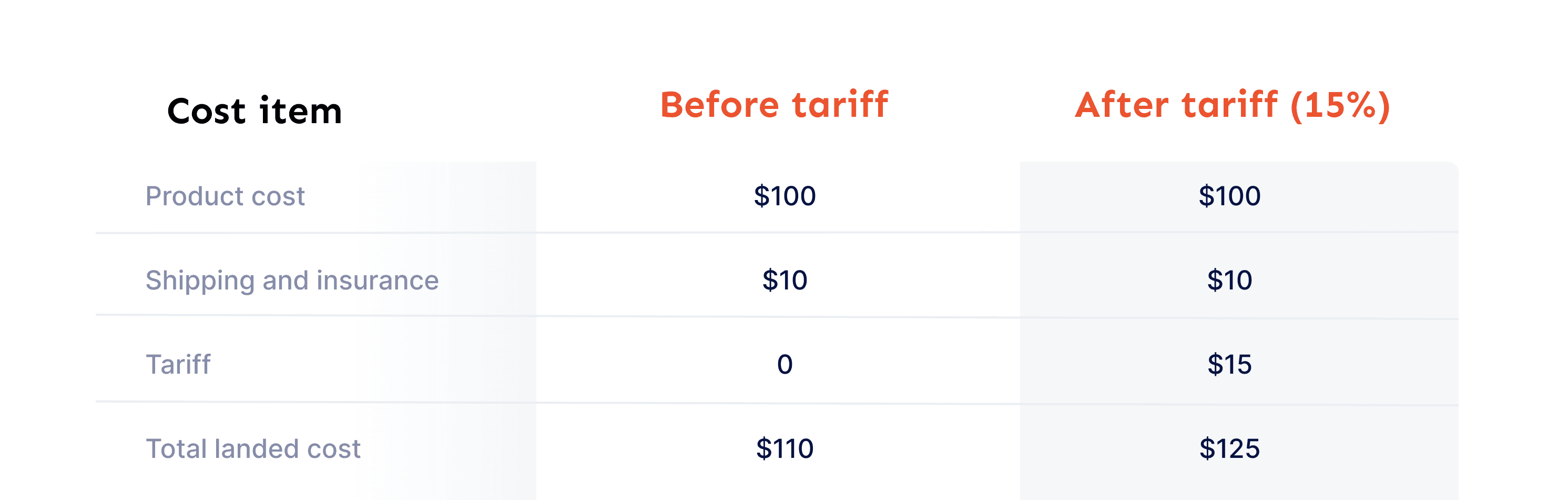
That’s a 13.6% jump in total cost per unit, and that too without changing the product quality or customer value. If this company sells 10,000 units a year, that’s $150,000 in additional costs, which can directly affect marketing budgets or cut profit targets.
A survey of 500 SMB leaders by Bredin gives us a clear picture of how decision-making shifts under cost pressure.
CFOs are the most trusted advisors during buying decisions, showing how critical financial leadership becomes when tariffs or trade costs rise.
Mid-sized businesses, those with 100-500 employees, ranked “rising costs” as one of their biggest challenges in 2024, right after access to credit.
This tells us something important: tariffs don’t just raise prices; they change how businesses think and decide. Financial advisors, CPAs, and vendor partners all become key voices in navigating the new normal of higher costs and tighter cash flow.
Key ways tariffs squeeze SMB profits
High tariffs lead to a chain reaction, apart from just the higher costs that SMBs face, and it hits their profits, pricing, and long-term competitiveness.
Rising input costs raise production expenses
Higher tariffs mean increased cost of raw materials, parts, and finished goods. These increased costs directly inflate production costs for small manufacturers and retailers. It's simple math: when your base cost rises, every downstream cost like packaging, transport, or even storage also rises.
Tough trade-offs: raise prices or take a margin hit
Once costs rise, it becomes a more difficult situation for SMBs because if they raise prices, they risk losing price-sensitive customers, and if they keep prices steady, their margins will be gone.
Tariffs disrupt supply chains and delivery timelines
Tariffs don’t just drive up costs; they slow things down, too. When importers struggle to manage higher duties or look for new suppliers, a lot of bottlenecks come into the picture, and uncertainty follows. Even a short delay can hurt SMBs, especially when they are waiting for a few weeks during a peak season. It means missed orders, lost sales, and frustrated customers.
Reduced competitiveness in local and global markets
When foreign competitors can import tariff-free or produce domestically at a lower cost, SMBs face a serious disadvantage. They either lose price competitiveness or are forced to compromise on product quality to stay affordable.
Limited access to capital and credit
Banks see inflated costs due to tariffs as an increased risk. This simply means they will put tighter lending terms or reduced credit limits for SMBs.
How can businesses manage high tariffs?
Tariffs might be non-negotiable, but how you respond to them isn’t. Smart SMBs are learning to adapt. They are rethinking pricing, supply chains, and cash flow strategies.
Here are the most effective ways to manage high tariffs without hurting your business:
Carefully manage price increases
Raising prices is tricky, especially when your customer loyalty is built on affordability. In such a case, focus on strategic adjustments. You can pass on costs gradually to customer segments that value quality or brand trust more than price. Another way is to try combining low-margin and high-margin items to balance them out. It's very important to communicate with customers openly. They respond better when price increases are explained as necessary responses to trade shifts rather than profit goals.
Make use of game theory
Yes, economics class finally pays off. Game theory helps businesses to think strategically when everyone is reacting to the same challenge, like in this case, it's tariffs.
For example, if all your competitors are raising prices hastily, you could just wait temporarily to capture the market, as it’s a good opportunity right there. Or, if they are delaying production to avoid import costs, you could just do the opposite to serve unmet demand.
The key is not to react emotionally but to anticipate competitors’ next move and position your business accordingly. Small moves can turn tariff shocks into competitive advantages.
Revamp your supply chain
Tariffs often expose overdependence on one supplier or region. This is the best time to diversify sourcing. You can start by exploring suppliers in countries with favorable trade agreements or lower duty structures. It’s also logical to bring parts of your supply chain closer to home so you can reduce long-term risk, even if short-term costs rise slightly.
Price hike without losing customers
Pricing is not only math; it’s more of perception. If you are raising prices by 10%, but simultaneously improving the product value by adding a warranty, free shipping, or better packaging, customers consider it fair. Think about value-based pricing instead of just adding a markup to your costs. Don’t raise prices only because your costs went up. You should be setting prices based on what your customer is willing to pay for the benefit or result your product gives them.
Set cash flow guardrails
Tariffs often lock up cash in duties and inventory, making cash flow management critical for survival. Businesses can stay steady by forecasting duty costs, renegotiating payment terms, and using automation tools to speed up incoming payments while delaying non-critical outflows. Platforms like Forwardly help by giving SMBs real-time visibility into payables and receivables, so they can plan ahead, schedule payments, and keep enough working capital free for duty and import expenses. According to the U.S. Small Business Administration (SBA), companies that use automated cash flow monitoring are 30% more resilient to sudden cost shocks.
Adopt technology
When tariffs rise the costs, technology can be your best defense. Businesses don’t need to panic after the damage is done; rather, they need to stay ahead with the right tools. You can have tools that can help you with tracking duties, managing expenses, and protecting cash flow in real time.
Trade management platforms, for instance, can automate tariff classification, calculate accurate landed costs, and keep you compliant as trade rules shift. That means there will be fewer errors, no surprise penalties, and not even overpaying on duties you didn’t owe in the first place.
But it's not only the imports that are affected by tariffs; your cash flow is also squeezed like anything, but that’s where payment automation platforms like Forwardly step in. Its AI-native payments help you to speed up receivables, automate outgoing payments, and keep your cash working smarter. This helps SMBs to hold funds longer, pay duties on time, and overcome those liquidity challenges that slow growth.
Know more about Forwardly. Take a 30-second product tour.
Simply put, technology helps SMBs stay financially agile in a tariff-heavy world. It allows tracking what’s due, freeing up cash faster, and ensuring no surprise costs derail operations.
Compliance and don’ts
High tariffs can make businesses do things that they shouldn’t. They might try tweaking product classifications or underreporting values to save a few bucks. But that shortcut can backfire fast. The penalties for getting caught are often worse than the tariff itself. We’re talking hefty fines, audits, and in some cases, outright import bans.
Rather, the safer path is to stay updated on trade codes, work with trusted customs brokers, and keep clear records for every shipment.
Turning tariff pressure into financial control
Tariffs may be beyond your control, but how you handle them isn’t. For SMBs, every duty increase impacts pricing, margins, and cash flow, but planning ahead makes all the difference.
Use forecasting, diversify suppliers, and adopt smart finance tools to stay steady. Platforms like Forwardly help you track payments, manage cash flow, and stay ready for unexpected costs.
Stay cash-flow confident with Forwardly. Sign up today.
By:
Maninder Sidhu
Published